Today marks the final day of the Spanish festival of San Fermin, a nine-day festival held since 1591. Tens of thousands of foreign visitors descend on Pamplona, Spain each year for revelry, morning bull-runs and afternoon bullfights. Although the tradition of bullfighting remains strong in Pamplona, opposition from animal rights groups remains high, and the parliament of the nearby Spanish province of Catalonia will soon be voting on a motion to outlaw bullfighting altogether. One new recent restriction in Pamplona - no vuvuzelas allowed. Sale of the noisy horns has been banned by the local government. Collected here are several photos of this years events in Pamplona, Spain. (40 photos total)
Click the image to see the full collection. Warning: Some images are graphic...AND I MEAN THIS!
After a month of matches, the 2010 FIFA World Cup Tournament is over, with Spain claiming its first ever trophy, the Netherlands placing second, and Germany taking third place. 32 teams came to South Africa last month, and the eyes of the world were upon them as television and online viewership broke records, and in many places productivity dropped sharply when matches were being played. Collected here are photos from the second half of the tournament (see earlier entries: 1, 2, 3), the action on the fields, and the reactions of those following the games in both South Africa and their home countries, as we bid farewell to the 2010 World Cup. (44 photos total)
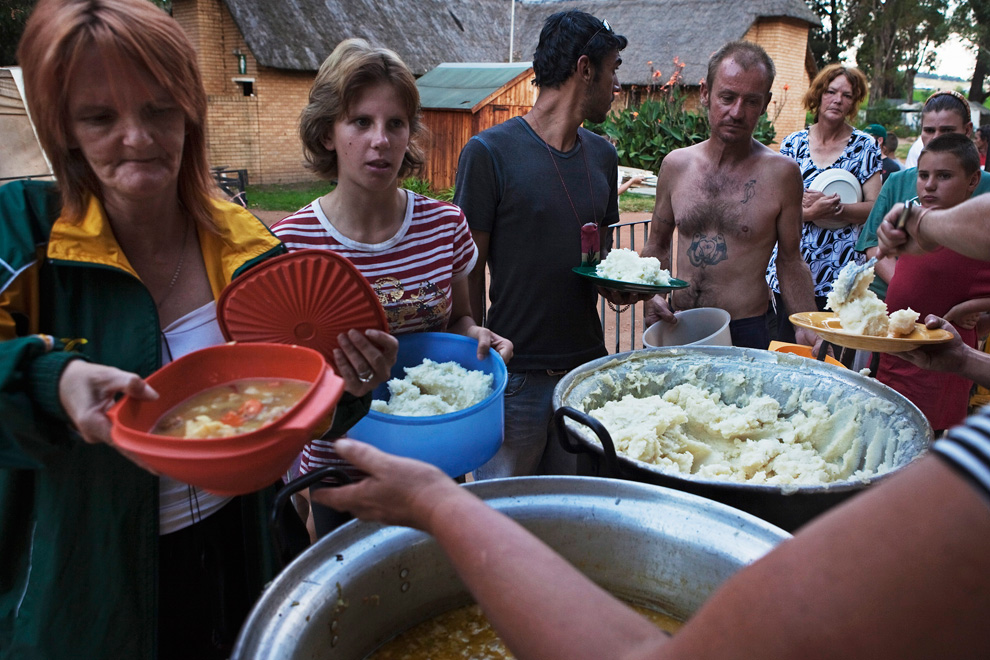
When stories are told about African poverty, race often seems to play a large part. Based in Senegal, Reuters photographer Finbarr O'Reilly (previously featured here for his work in DR Congo) traveled to South Africa earlier this year and visited one of a growing number of squatter camps populated mostly by Afrikaners - white South Africans - to document their stories and help show that, despite the fact that impoverished blacks in the region far outnumber whites, poverty is a human issue, not necessarily racial. O'Reilly: "While most white South Africans still enjoy lives of privilege and relative wealth, the number of poor whites has risen steadily over the past 15 years. Researchers now estimate some 450,000 whites, of a total white population of 4.5 million, live below the poverty line and 100,000 are struggling just to survive in places such Coronation Park, a former caravan camp currently home to more than 400 white squatters. Formerly comfortable Afrikaners recently forced to live on the fringes of society see themselves as victims of 'reverse-apartheid' that they say puts them at an even greater disadvantage than the millions of poor black South Africans." (27 photos total)
They eat up millions of your hard earned tax dollars. It’s money that could be used to keep your child’s school running. So with the internet and e-books, do we really need millions for libraries?
Libraries are quiet havens for the community. They take us to other worlds. They even make us laugh. But should these institutions — that date back to 1900 B.C. — be on the way out?
There are 799 public libraries in Illinois. And they’re busy. People borrow more than 88 million times a year.
But keeping libraries running costs big money. In Chicago, the city pumps $120 million a year into them. In fact, a full 2.5 percent of our yearly property taxes go to fund them.
That’s money that could go elsewhere – like for schools, the CTA, police or pensions.
With the summer solstice now two weeks gone, the northern hemisphere is heating up. High temperatures in some places have made working difficult and have taxed power grids as usage of electricity neared record levels in the U.S. This past weekend, the United States celebrated its 234th birthday on July 4th, with fireworks, parades and many other outdoor activities. Collected here today are a handful of recent photographs of people (and animals) either trying to beat the heat, or just enjoying a sunny summer's day. (40 photos total)
When it comes to children there are only two kinds of movies: The kind you show them to shut them up and the kind you share with them in the hopes they'll remember them for the rest of their lives. By the time my firstborn is six or seven, he or she will have seen more than his or her fair share of Nutty Professors or Shrek Forever Afters, and that's fine. But once your kids are old enough to remember, it becomes important to make sure you're also showing them something better.
Yet you can't wait around until they're old enough to really take in and appreciate movies like Rear Window or Lord of the Rings, let alone get literate enough to handle subtitles. By then it'll be too late. Beverly Hills Chihuahua VII will already own their brains. This weekend fathers around the country are taking their toddlers and pre-teens to see Toy Story 3, and while those kids have probably already forgotten Marmaduke, that Pixar experience is one they may remember for the rest of their lives.
It wasn’t snow nor rain nor heat nor gloom of night that stopped Chester Arthur Reed from his appointed round. The mail handler just felt it was time to call it quits at age 95.
The fork lift operator retired Wednesday as the nation’s oldest postal worker, ending a career without taking a single sick day. It’s a feat he attributes to a healthy diet of watermelon, alkaline water and an onion sandwich with mayo every day.
“If everyone in the nation ate watermelons, they’d get rid of all the doctors,” Reed said.
Despite being partially deaf and walking with a stoop, Reed has worked for more years than many of his co-workers have been alive and has accrued 3,856 hours — nearly two years — of sick leave for not missing a shift in 37 years.
Reed has been a U.S. Postal Service mail handler and forklift operator since he was hired in 1973, making $4 an hour. He hit the $25-an-hour ceiling about 10 years ago.
Reed said he likes his job because “one, it’s a steady income and, two, they don’t hassle you.” But he also knows when to leave, reasoning: “The Bible says there’s a time for everything. Well, it’s time to retire, and that’s it.”
Reed worked the 2:30 p.m. to 11 p.m. shift and logged in more than 12 hours some days, his 55-year-old manager Mary Brunkhorst said. “We’d have to force him to go home, and he’d say there’s still work to do. It takes a special person to work to age 95. Our generation would not do that.”